Loading...
Serving Mount Pleasant, SC and surrounding areas. (854) 858-0208
If your commercial space runs hot in summer and your utility bills have been climbing, your building is likely losing conditioned air. We insulate offices, retail spaces, and warehouses across Mount Pleasant.
If your commercial space runs hot in summer and your utility bills have been climbing, your building is likely losing conditioned air. We insulate offices, retail spaces, and warehouses across Mount Pleasant.
Commercial insulation in Mount Pleasant involves installing spray foam, blown-in, or rigid foam materials in a building's roof space, exterior walls, and mechanical areas to slow heat transfer and stop air leakage - and most single-space jobs are completed in one to three days.
Mount Pleasant has grown rapidly over the past two decades, and many commercial buildings along the Highway 17 corridor and in areas like Towne Centre were built during periods when energy codes were less strict than they are today. A building that looks modern on the outside may have insulation that does not meet current standards - and that gap shows up on your utility bill every month through a cooling season that runs from May through October. Pairing commercial insulation with crawl space vapor barrier work can address moisture issues that go hand-in-hand with inadequate insulation in the Lowcountry's climate.
For buildings where spray foam is the right fit, we also offer spray foam insulation with both open-cell and closed-cell options depending on the application. The choice between product types has real consequences in a coastal environment - we explain the tradeoffs in plain terms so you can make the call that is right for your building.
If your utility bills have been rising year over year, especially during Mount Pleasant's long cooling season from May through October, conditioned air is likely escaping through gaps in your building's insulation. This is one of the most common complaints from building owners along the Highway 17 corridor, where older strip-mall construction often has minimal wall insulation.
If one corner of your office or retail space feels noticeably warmer or cooler than the rest, insulation is uneven or missing in that area. Uneven temperatures are especially common in buildings with flat or low-slope roofs - a design widespread in Mount Pleasant's commercial districts - where heat radiates directly through the roof deck.
Drafts are a sign that air is moving freely through gaps in the building envelope. In a coastal area like Mount Pleasant, where sea breezes and storm winds are common, those gaps can let in not just air but moisture. If you can feel a draft near an exterior wall on a windy day, the insulation in that area is almost certainly inadequate.
In Mount Pleasant's humid climate, water stains, peeling paint, or visible condensation on interior surfaces often signal that insulation is not managing vapor movement correctly. Left unaddressed, moisture intrusion in a coastal climate can lead to mold growth and structural damage relatively quickly - especially in buildings that have never been assessed.
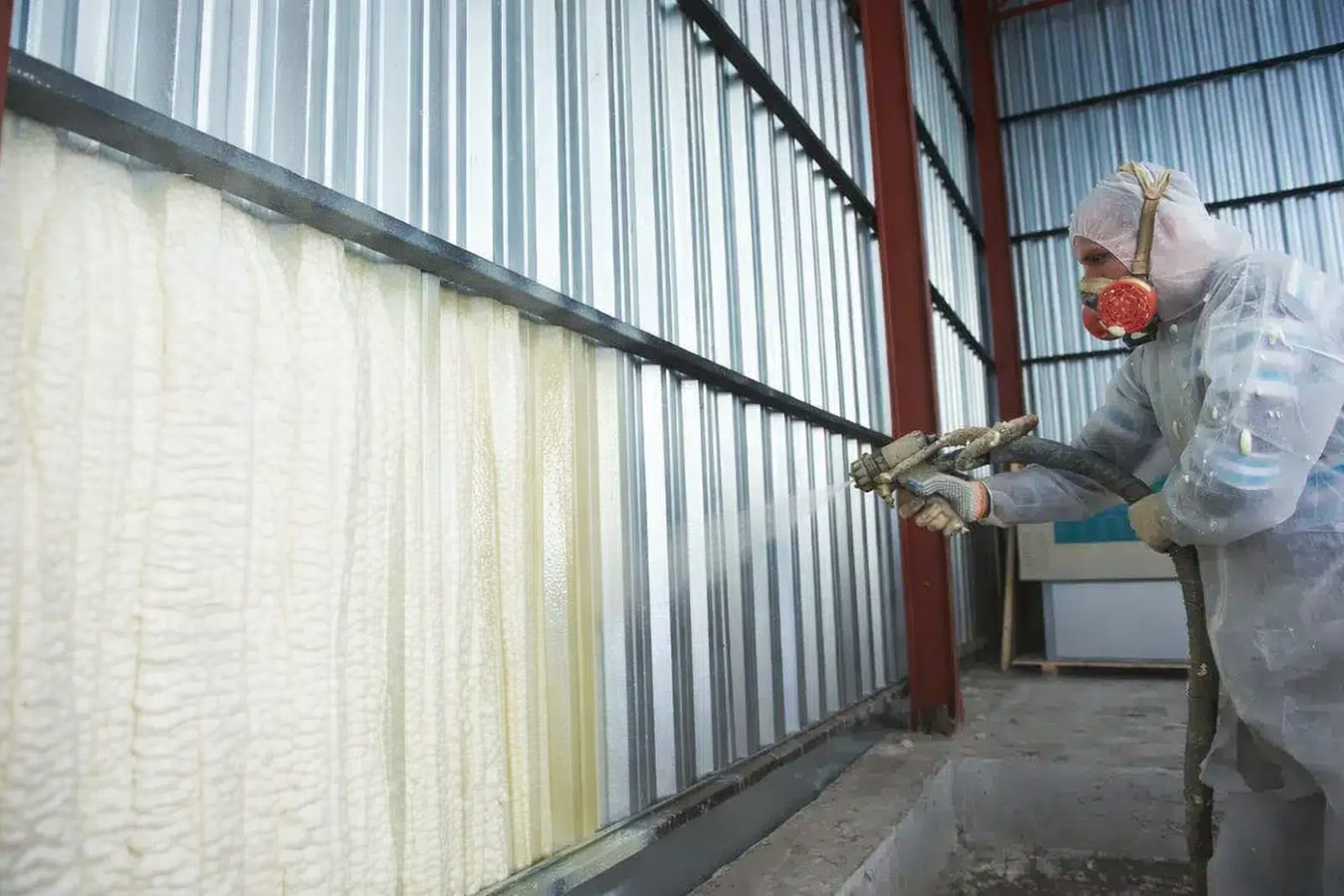
We install spray foam, blown-in, and rigid foam board insulation for commercial buildings across Mount Pleasant and the broader Charleston metro. For roof spaces and attics, we assess whether your building benefits more from insulation at the ceiling level or at the underside of the roof deck. For exterior walls, we look at whether the existing insulation can be supplemented or needs to be removed and replaced. If moisture has already gotten into wall cavities, we address that before any new material goes in - otherwise new insulation will fail just as quickly as the old.
For buildings in coastal zones where moisture resistance is a priority, closed-cell spray foam is often the strongest choice - it creates an air seal and a moisture barrier at the same time. For buildings where budget is the primary consideration and the space allows it, blown-in insulation in the attic is typically the most cost-effective first step. We walk you through the options specific to your building and your goals before any work begins.
Best for buildings where both air sealing and insulation are needed at once - particularly effective for roof deck applications and coastal environments.
A cost-effective option for attic spaces and wall cavities in buildings where spray foam is not required - typically the least disruptive to ongoing operations.
Common in wall assemblies and under roofing - provides continuous insulation that reduces thermal bridging through the framing.
For older commercial buildings where existing insulation has deteriorated, compacted, or was installed incorrectly - clearing the way for a properly installed system.
Mount Pleasant sits in one of the most humid regions in the continental United States, and that moisture-laden air puts constant pressure on a building's envelope. Insulation here is not just about keeping heat out in summer - it is about managing moisture year-round so walls and ceilings do not become breeding grounds for mold. South Carolina adopted updated commercial energy requirements in recent years, and older buildings in Mount Pleasant's commercial districts were often built to standards that are now significantly below what is required. If your building was constructed before 2012, a walkthrough assessment may reveal that you are paying considerably more in utility costs than you should be. The North American Insulation Manufacturers Association publishes installation guidelines that reflect current best practices for commercial applications in climates like ours.
Hurricane season is also a real factor in this market. Scheduling commercial insulation work before hurricane season - ideally in late winter or early spring - means your building is better protected before the most demanding weather arrives. We serve commercial properties throughout the area, including North Charleston and Goose Creek, where many of the same coastal building challenges apply.
We ask a few basic questions about your building - its size, age, how it is used, and what problems you have been noticing. Most Mount Pleasant businesses can schedule a site visit within a few business days.
We walk through your building and look at the areas most likely to be losing energy. We may use a thermal imaging camera to identify problem spots that are not visible to the naked eye, then give you a clear picture of what we recommend.
We follow up with a written estimate that breaks down scope, materials, and total cost. We also confirm whether a permit is required for your project and handle the application on your behalf if so.
Our crew works through the areas in your estimate, protecting surfaces they are not touching and checking in if they encounter anything unexpected. Before leaving, we walk you through what was installed and where.
Free, no-pressure walkthrough assessment. Written estimate included. We reply within one business day.
(854) 858-0208We work exclusively in the Charleston metro area, so every commercial job accounts for the Lowcountry's humidity, salt air, and building code requirements. A contractor who works primarily in drier markets will not make the same material and installation choices we do.
Commercial insulation work in Charleston County typically requires a permit - and we handle the entire process. We submit the application, coordinate the inspection, and make sure your project is fully documented so there are no surprises if you sell or refinance the building.
Before any work begins, you receive a fully itemized written estimate that covers scope, materials, and price. If we encounter something unexpected during work - such as deteriorated insulation inside a wall - we call you before proceeding, not after.
In a coastal area that takes hurricane season seriously, the type of insulation matters beyond energy savings. When spray foam is the right choice for your building, we explain how it contributes to structural resilience - not just comfort - so you can make a fully informed decision.
Commercial insulation is a straightforward investment when done correctly - you see the return on your utility bills within the first full billing cycle. Every job we do is built on a clear written estimate, properly permitted work, and a final walkthrough so you know exactly what was installed.
Learn more about commercial energy requirements through the South Carolina Energy Office.
Ground-level moisture control that works alongside insulation to keep humidity out of crawl spaces in Lowcountry commercial buildings.
Learn MoreOpen-cell and closed-cell spray foam applications for commercial spaces requiring maximum air sealing and moisture resistance.
Learn MoreCooling season is long and expensive in the Lowcountry - the sooner your building is properly insulated, the sooner those savings show up on your bill.